

Most people judge a room by its walls, floors and furniture, yet the single largest painted surface in almost any room sits overhead. Ceilings were textured for practical reasons long before anyone thought of texture as a style. A sprayed or troweled pattern covered tape joints, uneven framing and rushed drywall work far faster than a perfectly smooth finish could. That is why so many older homes in Middle Georgia still carry popcorn, swirls or knockdown above every room, and each of those patterns says something about when the house was finished and what may be sitting underneath.
Because ceiling problems rarely stay cosmetic for long, the most useful help comes from crews that treat drywall, texture and paint as one connected job rather than three separate calls. Homeowners around Warner Robins and Macon who bring in Complete Coverage Painting get sheetrock repair, ceiling texture work and painting handled together, and that matters more than it sounds, since a freshly painted ceiling only looks right when the patches beneath it disappear completely.
Patterns That Give Away a Home’s Age
The pattern overhead often hints at a home’s age before anyone checks the records. Warner Robins and Macon both have large stocks of postwar and later ranch homes, and their ceilings tend to fall into a handful of familiar families.
- Popcorn or acoustic spray has a lumpy, cottage cheese look and was common from the 1950s into the 1980s. It softened echoes and hid flaws, but it traps dust and cobwebs and crumbles when scrubbed.
- Swirl and stipple patterns were brushed or rolled into wet compound, creating fans, crow’s feet or rosettes. They are common in 1960s and 1970s homes and hard to copy.
- Orange peel is a fine spatter that leaves a subtle dimpled surface. It hides minor flaws without looking heavy.
- Knockdown starts as a heavier spatter that gets flattened with a wide knife once it partly sets, leaving flat islands of mud. Many homes built from the 1990s onward use it.
- Skip trowel is applied by hand in thin, uneven passes and reads as more artisan than production.
- Smooth finishes require the most skilled taping and sanding and remain the choice in many newer custom builds.
Knowing which family a ceiling belongs to tells a painter how repairs must be blended and whether extra precautions come first.
Stains, Cracks and Bumps That Appear Overhead
Ceilings in this part of Georgia deal with a specific mix of stresses. Long, humid summers push attic temperatures far above outdoor readings, and ductwork running through those attics can sweat when cold air passes through it. That condensation drips onto the drywall and leaves rings around supply registers or along the path of a duct. A clogged condensate line or a rusted drain pan under an attic air handler produces a similar stain, often directly beneath the unit.
Roof leaks leave a different signature. Their stains usually sit away from vents, darken after storms and dry with brown edges.
Cracks deserve their own reading. A crack that opens along the corner where wall meets ceiling every winter and closes again in summer often points to truss uplift, where roof trusses flex as the attic dries and cools. Filling that joint with hard compound fails repeatedly, so experienced crews switch to flexible caulk or a floating corner technique. Nail pops, small round bumps in neat rows, come from framing that shrank after the drywall went up. Sagging between framing members suggests drywall that has absorbed moisture over time, which is why ceiling board designed to resist sag is now the standard choice on wider spacing.
Matching Old Texture Is Its Own Craft
Repairing a section of textured ceiling looks simple until the patch dries and stands out under the first afternoon sun. A clean, invisible repair usually follows a careful sequence.
- Solve whatever caused the damage, whether it was a roof flashing, a duct seal or a condensate line.
- Cut out drywall that stayed wet or soft, since stained but firm board can usually stay.
- Install new board, tape the seams and feather the compound so no ridge remains.
- Test the texture on a scrap piece first, adjusting the mud’s thickness, spray pressure and knockdown timing until the pattern matches.
- Prime the repair and then repaint the entire ceiling plane from corner to corner, because touched up spots on a ceiling almost always flash under raking light.
That last step surprises many homeowners, but an older ceiling has yellowed slightly, so even the same color will look different on a small patch.
Smooth Ceilings Look Better on Paper
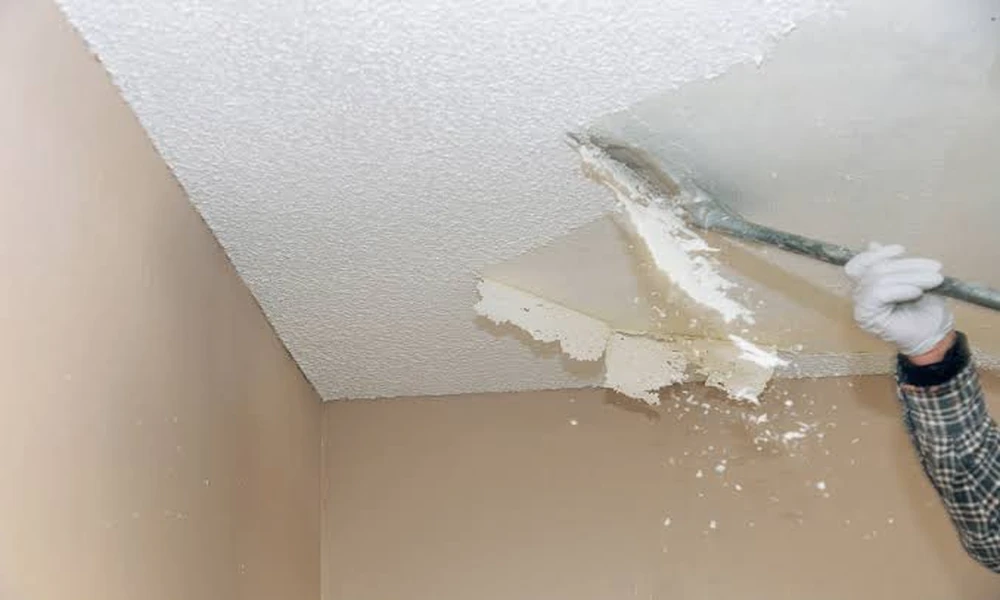
Scraping off popcorn is one of the most requested ceiling upgrades, and in many rooms it pays off with a cleaner, brighter look. The part that gets overlooked is what waits under the texture. Builders who planned to spray popcorn rarely finished the seams well, so removal often exposes rough tape joints that need a full skim coat, and that labor is where budgets grow.
Smooth ceilings also reveal every imperfection when light skims across them. Large west facing windows and rows of recessed lights expose ripples that texture would have hidden. For those spaces, replacing popcorn with a light knockdown or orange peel often gives the updated look without demanding a flawless surface.
The Test Before Any Scraper Touches the Ceiling
Homes finished before the 1980s carry another consideration. Some spray textures, patching compounds and textured paints from that era contained asbestos, and no one can confirm its presence by looking. A small sample sent to an accredited lab gives a definite answer before anyone sands, scrapes or drills. According to the Consumer Product Safety Commission guide on asbestos in the home, material in good condition is usually best left undisturbed, while damaged material or planned removal calls for trained professionals.
When a test comes back positive and the ceiling is intact, encapsulating it with paint is one common route. Sprayed coats work better than rollers here, because a heavy roller can pull loose texture down with it. Lead in older paint layers is another reason to test before sanding overhead.
Paint That Belongs Above Eye Level
Ceiling paint is formulated differently from wall paint for good reasons. It is usually flat, since any sheen exaggerates texture and shadows, and thicker bodied so it spatters less when rolled overhead. Water stains and old smoke marks need a dedicated stain blocking primer, often shellac or oil based, because standard latex lets those marks bleed right back through within days.
Bathrooms and laundry rooms call for finishes with mildew resistance, paired with exhaust fans that actually vent outdoors instead of into the attic. Color matters too, since pure white can feel stark against warm walls while a lightly tinted ceiling makes a room feel finished.
A ceiling that has been read correctly, repaired properly and painted with the right products fades from notice, which is exactly its job. The next time a ring, crack or crumbling patch appears overhead, it is worth treating as a message about the house rather than just a spot that needs another coat.
