

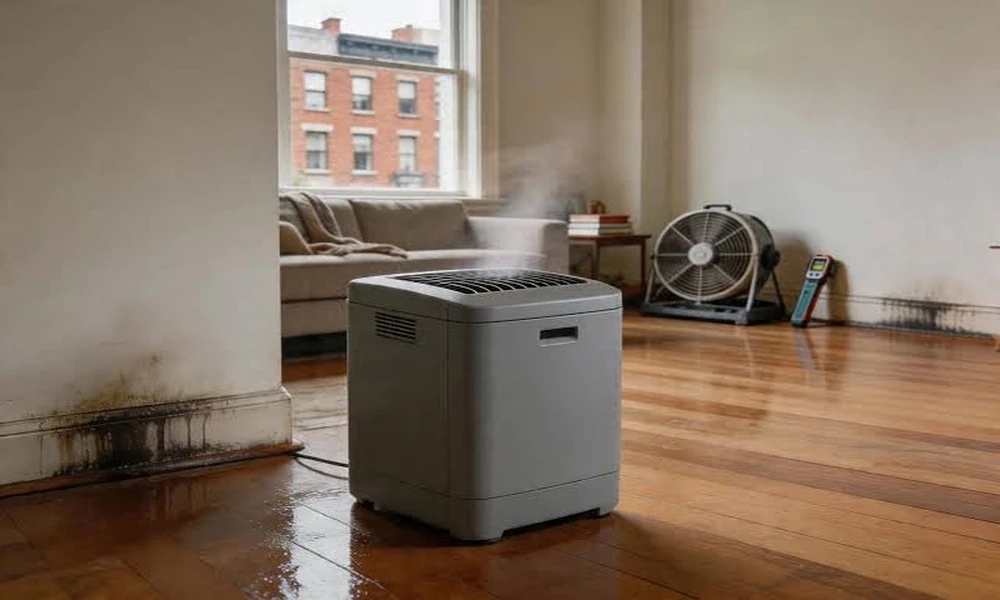
The first hour after a water incident can create a long shopping list. In a ground-level studio after a slow plumbing leak affected flooring near a wall of stored materials, a better approach is to name the condition that needs to change, then choose a restoration dehumidifier only if it fits that job.
Make ground-level studio safe to assess
What stands out here is a broad damp area, a closed rear corner and dust released while items are sorted. It should be recorded before furniture, runners or stored items are put back, since those objects can hide the area that needs the clearest follow-up.
For a ground-level studio after a slow plumbing leak affected flooring near a wall of stored materials, the most useful note is not a claim about what caused the problem. It is a short observation of what was touched, what was moved and what remains uncertain. That restraint is valuable because the next step may involve a supplier, insurer, electrician or restoration professional who needs facts rather than a confident guess.
Work from the wettest material outward for ground-level studio
It is tempting to solve the problem by choosing a large unit because the room feels spacious without checking what part of the room is actually wet. The room benefits more from a pause that separates what is visible from what needs to be checked.
The constraint is not merely physical space. Where a broad damp area, a closed rear corner and dust released while items are sorted, the plan should also account for ventilation, noise, drainage handling and the need to revisit the same area. Those factors can change whether a category is appropriate and where it can be used responsibly.
For this situation, separate the moisture-control question from the particle-control question, then place equipment around the affected materials rather than the open centre. That keeps the equipment choice tied to a measurable job instead of a vague desire to dry everything faster.
This is why separate the moisture-control question from the particle-control question, then place equipment around the affected materials rather than the open centre belongs ahead of a generic request for ‘dryers.’ The role of the equipment should be clear enough that a reader can explain what it is expected to change in the first hours and what it cannot be expected to prove. That distinction also keeps a supplier conversation focused on the room rather than on a shopping list.
Consider the room from the perspective of the least convenient material. In a ground-level studio after a slow plumbing leak affected flooring near a wall of stored materials, that may be the area described as a broad damp area, a closed rear corner and dust released while items are sorted, not the part of the floor that is easiest to reach or explain.
A plan built around that inconvenient spot will usually be more honest about placement, access and time. It also makes choosing a large unit because the room feels spacious without checking what part of the room is actually wet less likely, because the plan has been designed around the part most likely to be missed in a ground-level studio after a slow plumbing leak affected flooring near a wall of stored materials.
The rental choice can then stay modest and purposeful: separate the moisture-control question from the particle-control question, then place equipment around the affected materials rather than the open centre. That is a better standard than trying to make the whole room look normal in one pass.
The checklist is intentionally practical: make the area safe, expose what needs to be inspected, address the held water or air condition, and return to whether the rear corner and the open work area are improving at comparable rates. It avoids turning a ground-level studio after a slow plumbing leak affected flooring near a wall of stored materials into a generic emergency story with a preselected answer.
That order is particularly important because choosing a large unit because the room feels spacious without checking what part of the room is actually wet can hide the clue that changes the next step. A checklist is useful only when it helps the reader stop, observe and choose a response that fits the material in front of them.
Use equipment for a specific condition for ground-level studio
If the inspection points toward this role, a restoration dehumidifier rental resource for Newmarket provides a practical place to compare the category against a broad damp area, a closed rear corner and dust released while items are sorted and the access limits in the room.
A ground-level studio after a slow plumbing leak affected flooring near a wall of stored materials may need more than one step without needing every available category. The point is to identify what comes first, what can wait and what does not belong in the plan at all.
For readers comparing the next stage, the rental listing for Newmarket HEPA air scrubber offers a distinct category to review. Its placement should remain different from the first rental choice in a ground-level studio after a slow plumbing leak affected flooring near a wall of stored materials.
Decide what would justify a different next step for ground-level studio
Keep the review specific: whether the rear corner and the open work area are improving at comparable rates. A clear checkpoint makes a rental decision accountable to the room rather than to optimism.
The closing check should focus on whether the rear corner and the open work area are improving at comparable rates. It is worth writing that condition down before equipment is moved, because it gives the household a defensible way to decide whether to continue, reposition, add another category or stop and seek a closer assessment.
A large space still benefits from a small, precise plan.
